Same-Day Emergency Tooth Extraction in Antioch: Who Needs Immediate Treatment?


A throbbing tooth at midnight or a sudden crack while eating dinner can turn a normal day upside down. If you live in Antioch, CA and you're wondering whether your dental pain can wait or needs care right now, you're not alone.
Many dental emergencies do require same-day attention, but not every toothache means you need a tooth pulled today.
The clearest sign you need a same-day emergency tooth extraction is pain or swelling that keeps getting worse, does not respond to medicine, or comes with facial swelling and fever.
Other situations, like a small chip or a lost filling, often can wait for the next open appointment with your regular dentist. Knowing the difference helps you make a calm, informed decision instead of panicking or ignoring a problem that needs fast care.
This kind of decision is not something to guess at alone. If you need emergency tooth extraction in Antioch, CA, a dentist can examine the tooth, take an X-ray, and determine whether it needs to come out or can be saved.
Key Takeaways
- Severe pain, spreading swelling, or a tooth broken beyond repair usually means same-day extraction is the safer choice.
- Simple first-aid steps like a cold compress and careful bleeding control can protect your comfort until you reach a dentist.
- Many damaged teeth can be saved with a root canal or restoration, so an in-person exam matters before assuming extraction is the only option.
Who Needs an Extraction Without Delay?
Certain symptoms point clearly toward same-day emergency tooth extraction, while others are uncomfortable but not urgent. The biggest warning signs involve pain that will not quit, infection that is spreading, and tooth damage that is too severe to repair.
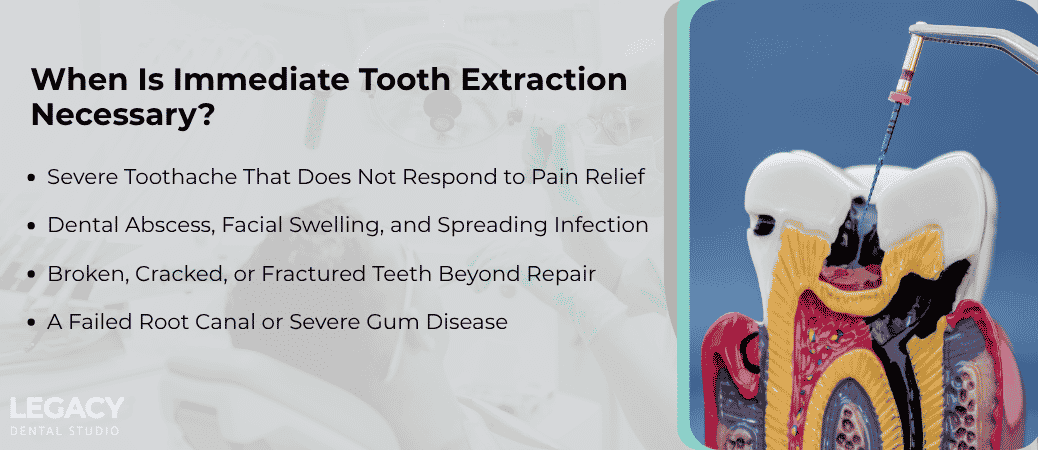
Severe Toothache That Does Not Respond to Pain Relief
A severe toothache that keeps you up at night or does not ease after taking over-the-counter pain relief is a red flag. Persistent tooth pain that is throbbing, sharp, or getting worse over a day or two often points to deep decay or infection at the tooth's nerve.
If pain relief medicine barely touches your tooth pain, that is your body telling you the problem is bigger than a surface irritation. Waiting it out rarely helps and can let the damage spread further into the tooth.
Dental Abscess, Facial Swelling, and Spreading Infection
A dental abscess with facial swelling is one of the most urgent signs you can have.
An abscess is a pocket of infection, and if the swelling is moving toward your eye, jaw, or neck, or if you develop a fever, that infection is spreading and needs same-day treatment.
Left alone, severe throbbing pain that spreads to the jaw, cheek, or neck along with fever and swelling can signal a dangerous infection that needs immediate care.
Broken, Cracked, or Fractured Teeth Beyond Repair
A broken or fractured tooth with extensive damage below the gumline may be difficult or impossible to restore, depending on the extent of the damage.
When a tooth is broken down that far, extraction may be the safer option even when the pain feels manageable. Sharp edges can also cut your cheek or tongue, adding injury on top of injury.
A Failed Root Canal or Severe Gum Disease
A tooth that already had a root canal can still become reinfected, and in some cases the tooth cannot be saved a second time. Severe gum disease can also loosen a tooth so much that it no longer has enough bone support to keep it in place.
In some cases, extraction may be necessary when the tooth cannot be saved or infection cannot be adequately controlled with other treatment.
What to Do Before You Reach an Emergency Dentist
The right first-aid steps can keep pain and swelling under control while you get to an emergency dentist. What you do in the first hour after a dental injury or flare-up of pain can make a real difference in your comfort and in how well the tooth responds to treatment.
How to Manage Pain and Swelling Safely at Home
Rinse gently with warm salt water and apply a cold compress to the outside of your cheek for 15 to 20 minutes at a time. This simple pain management step helps reduce swelling and can take the edge off tooth pain while you arrange care with an Antioch emergency dentist.
Avoid putting aspirin directly on the gum, since it will not help the tooth and can burn soft tissue. Over-the-counter pain relief taken as directed on the label is a safer way to manage discomfort until you are seen.
What to Do With a Knocked-Out Tooth or Dental Trauma
A knocked-out tooth has the best chance of being saved if you act within the first 30 to 60 minutes. Pick the tooth up by the crown, never the root, rinse it gently with water if it is dirty, and try to place it back in the socket. If that is not possible, keep it in a small container of milk or saliva and get to an emergency dentist right away.
Other dental trauma, like a tooth pushed out of position or a large chip, also needs prompt attention. The faster a dentist evaluates the injury, the better the odds of protecting the tooth and surrounding bone.
When Uncontrolled Bleeding or Swelling Means Go to the ER
Uncontrolled bleeding that will not stop after 15 to 20 minutes of firm pressure, or swelling that is making it hard to breathe or swallow, is a medical emergency. In these cases, go to the nearest emergency room instead of waiting for a dental office to open.
Once you are medically stable, follow up with an emergency dentist for the actual tooth problem, since emergency rooms are not set up to treat the tooth itself.
What Happens During a Same-Day Extraction Visit?
A same-day extraction visit starts with an exam and X-ray so the dentist can confirm whether the tooth can be saved or needs to come out.
From there, the appointment moves through numbing, the extraction itself, and clear instructions for the first day of healing.
How an Emergency Dentist Decides Whether a Tooth Can Be Saved
Dentists look at the amount of remaining healthy tooth structure, how deep the decay or fracture goes, and whether infection has reached the bone. An urgent visit does not automatically mean the tooth comes out.
Your dentist's first priority is controlling discomfort and figuring out whether saving the tooth is realistic before recommending extraction.
An experienced dentist like Dr. George Saleeb can evaluate the damaged tooth, review X-rays, and determine whether it can be restored or needs extraction.
Local Anesthesia, Sedation Options, and Comfort During Treatment
Local anesthesia numbs the tooth and surrounding gum so you should not feel pain during the extraction, though you will feel pressure.
For patients who are anxious or need a more involved surgical extraction, conscious sedation may also be offered alongside the numbing medicine.
Emergency dentistry teams are used to working with nervous patients and will walk you through each step before it happens.
What to Expect During Simple and Surgical Tooth Extraction
A simple extraction is used when the tooth is visible above the gumline and can be loosened and lifted out with dental instruments.
A surgical tooth extraction is needed when the tooth has broken at the gumline or the roots are curved, which may require a small incision or splitting the tooth into pieces for removal.
Most simple extractions are finished in under an hour, including time for numbing and post-procedure instructions.
First-Day Recovery Steps That Protect the Blood Clot
The blood clot that forms in the socket protects the bone underneath and needs to stay in place for proper healing. Skip straws, spitting hard, and smoking for at least 24 hours, since suction can dislodge the clot and lead to a painful condition called dry socket.
Stick to soft foods, bite gently on gauze as directed, and keep up gentle oral hygiene around the area, avoiding the extraction site itself for the first day.
Can a Damaged Tooth Be Repaired Instead?
Many damaged teeth can be treated without extraction, especially when the problem is caught early. A dentist will only recommend pulling a tooth when repair options will not hold up long term.
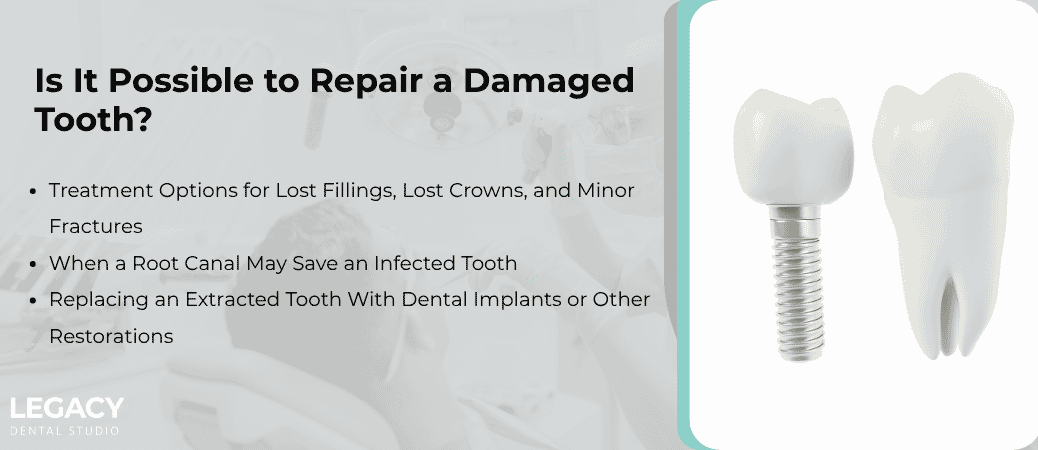
Treatment Options for Lost Fillings, Lost Crowns, and Minor Fractures
A lost filling or a lost crown can often be replaced without needing to remove the tooth, as long as there is enough healthy structure left underneath. Minor chips and small fractures may be treated with bonding or a new crown through restorative dentistry.
If you've had a crown come off unexpectedly, getting it looked at quickly gives you the best shot at saving the natural tooth. Cosmetic dentistry can also address minor chips once the underlying health of the tooth is confirmed.
When a Root Canal May Save an Infected Tooth
A root canal removes infected tissue from inside the tooth while leaving the outer structure in place, which is often a better long-term option than extraction.
This treatment works well when enough healthy tooth structure remains and the infection has not destroyed the supporting bone.
If you're dealing with a tooth infection, a root canal can sometimes resolve the problem in one or two visits, and understanding the root canal recovery timeline can help you plan your week around the appointment.
Replacing an Extracted Tooth With Dental Implants or Other Restorations
When extraction is unavoidable, dental implants are a common way to replace the missing tooth and restore normal chewing function. Other restorative options include a bridge or a partial denture, depending on your bite and budget.
Patients considering an implant can review this complete guide to dental implants in Antioch to understand timelines and what the process involves, since waiting too long to replace a missing tooth can affect nearby teeth and bone.
Paying for Urgent Dental Treatment in Antioch
The cost of an emergency tooth extraction depends on the type of extraction and the treatment you need. Legacy Dental Studio works with PPO dental insurance benefits and offers financing options that can help patients manage treatment costs.
Dental Insurance for Emergency Treatment
If you have dental insurance, your benefits may help with eligible emergency treatment. Coverage and out-of-pocket costs depend on your individual plan, so benefits should be verified before treatment whenever possible.
Legacy Dental Studio works with PPO insurance benefits, including Delta Dental, Cigna, Principal, MetLife, Guardian, and other supported plans. Review the practice's insurance and financing options for more information.
Financing and Payment Options
If you need help managing treatment costs, Legacy Dental Studio offers financing options including CareCredit, Alphaeon, and Cherry. Ask the dental team which option may fit your treatment and budget.
Why the Emergency Room Usually Cannot Treat the Tooth
Emergency rooms can treat swelling, infection, and severe pain with antibiotics or medicine, but they generally do not have the tools or staff to actually remove a tooth.
If you go to the ER for a dental issue, you will likely still need a follow-up visit with an emergency dentist in Antioch to have the tooth extracted or repaired.
Reserving the ER for uncontrolled bleeding, severe swelling that affects breathing, or high fever keeps your care on the fastest path.
Prompt Care Can Protect Your Comfort and Oral Health

Acting quickly on severe tooth pain, swelling, or a badly damaged tooth protects both your comfort and your long-term oral health. Waiting on symptoms like spreading infection or facial swelling only gives the problem more time to get worse and more expensive to treat.
Patients in Antioch should seek prompt professional care when severe pain, swelling, or dental trauma requires urgent attention.
Reaching out to an Antioch dental team such as Legacy Dental Studio as soon as symptoms start gives you the best chance at a comfortable outcome, whether that means saving the tooth or moving forward with extraction and a solid replacement plan.
Frequently Asked Questions
Can you get a tooth pulled as an emergency?
Yes. A dentist may perform an emergency tooth extraction the same day when a tooth is causing severe pain, is badly damaged, or cannot be saved. An exam and X-ray during the visit confirm whether extraction is the right choice.
Will a dentist pull an infected tooth the same day?
Often, yes, especially if the infection is spreading or causing significant swelling. Same-day emergency tooth extraction is commonly performed once a dentist confirms the tooth cannot be saved and removal is safe based on your health history.
Can I get a tooth pulled out at the ER?
Generally not. Emergency rooms can treat pain, swelling, and infection with medicine, but most do not have a dentist on staff to perform extractions. You will likely need a follow-up visit with an emergency dentist to actually have the tooth removed.
What should I do if I have a dental emergency in the middle of the night?
Manage pain with a cold compress and over-the-counter pain relief, and avoid hard or hot foods until morning if the situation is stable. If you have uncontrolled bleeding, severe swelling near your throat, or trouble breathing, go to the emergency room right away instead of waiting.
How long does pain last after an emergency tooth extraction?
Most people feel noticeable soreness for two to three days, with swelling improving steadily after the first 48 hours. Following your dentist's aftercare instructions, including protecting the healing blood clot, helps keep discomfort manageable and lowers the risk of complications like dry socket.