How to Afford Dental Implants Without Insurance
A missing tooth is stressful enough. If you're looking for affordable dental implants, understanding treatment costs, financing, and payment options can help you make a more informed decision.
You can get a dental implant without coverage, and plenty of people do it every year without draining their savings or signing up for debt they regret.
The path there starts with knowing exactly what you're paying for, where you can trim the price safely, and how to compare financing options so the monthly payment doesn't hide a bigger cost down the road.
Affording dental implants without insurance starts with understanding your itemized treatment cost, reviewing available payment options, and choosing financing that fits your budget without overlooking the total repayment amount.
Skip straight to financing before you've done the first two steps, and you risk paying more than you need to for the same result.
Key Takeaways
- A clear, itemized treatment plan helps you understand what is included in your estimated cost and which procedures may affect the total.
- Reviewing your treatment plan, insurance benefits, available financing, and HSA or FSA funds can help you understand ways to manage your out-of-pocket dental implant costs.
- Reviewing financing terms carefully can help you understand the total repayment amount before committing to a payment option.
What Will Your Implant Treatment Actually Cost?
Most single dental implants run between roughly $3,000 and $6,000 out of pocket, while full-mouth dental implants can climb into the tens of thousands depending on how many teeth need replacing and what preparatory work is required.
The final number depends heavily on your jawbone density, how many teeth you're replacing, and whether you need extractions first.
Getting a precise number matters more than guessing from an average, because your mouth's condition drives most of the variation.
What Is Included in the Cost of a Single Dental Implant?
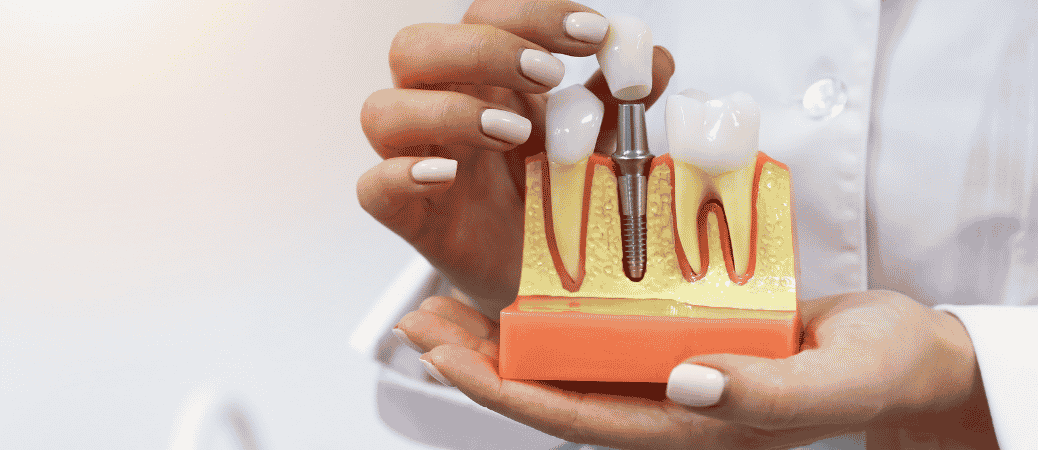
A single implant is really three separate parts billed together. The implant post (the titanium or zirconia piece that acts as your artificial tooth root) typically costs $1,000 to $2,000, the abutment that connects it to your new tooth runs $300 to $700, and the crown adds another $1,000 to $2,500 depending on material.
Most offices quote these three pieces as one bundled price. Consultations, imaging, and follow-up visits are sometimes billed separately, so ask for a full written plan before you commit.
What Do Full-Mouth Dental Implants Cost Without Insurance?
Full-mouth restoration involves replacing an entire arch or both arches, and the price reflects that scale.
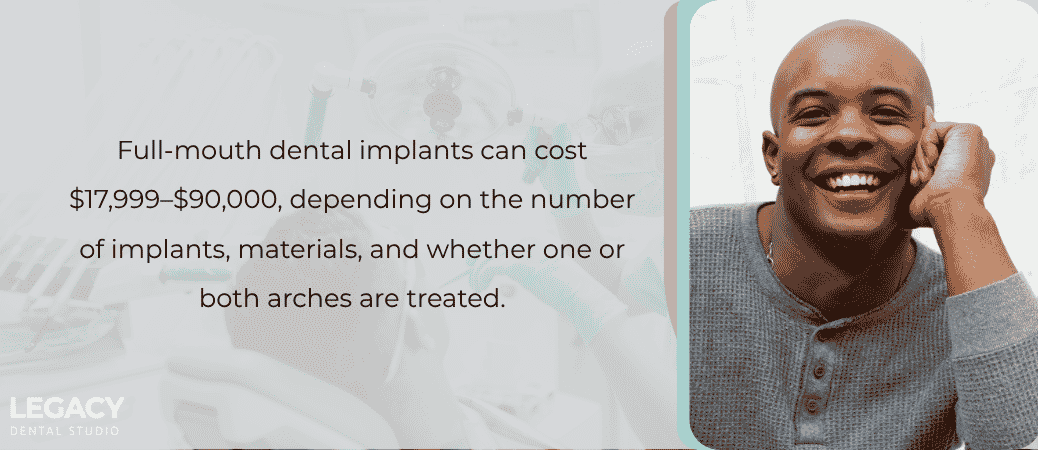
Estimates for full-mouth dental implants commonly range from roughly $17,999 per arch on the lower end to $60,000 to $90,000 for more extensive full-mouth restoration.
The wide range comes down to how many implant posts anchor the arch, the materials used for the prosthetic teeth, and whether both the upper and lower jaw need treatment.
At Legacy Dental Studio, Dr. George Saleeb can evaluate your oral health and explain which implant treatment options may be appropriate for your needs.
Which Preparatory Procedures Can Raise the Estimate?
Preparatory procedures are the most common reason a quoted price grows. If your jawbone doesn't have enough density to support an implant post, you may need bone grafting to build it up, or a sinus lift if the implant is going into your upper jaw near the sinus cavity.
Tooth extractions are another frequent add-on, especially if the damaged tooth is still in place.
An oral surgeon typically evaluates these needs using imaging like a CBCT scan, and oral surgeons or periodontists often handle the surgical placement itself while a restorative dentist completes the crown.
Ask specifically whether your quote already accounts for grafting, extractions, or a sinus lift. Skipping this question is one of the fastest ways to be blindsided by a bill that's double the number you expected.
Use Tax-Advantaged Funds and Financing Carefully
Pre-tax accounts and financing both stretch your budget, but they work in very different ways.
An HSA or FSA lets you pay with money you never paid income tax on, while dental financing spreads the cost into payments, sometimes with interest attached and sometimes without.
Can You Use an HSA or FSA for Dental Implants?
Yes, both a health savings account (HSA) and a flexible spending account (FSA) can be used to pay for dental implants, since the IRS classifies them as a qualified medical expense.
HSAs roll over year to year and belong to you even if you change jobs; FSAs typically have a "use it or lose it" rule tied to your plan year, so check your specific plan's deadline.
Using pre-tax dollars from an HSA or FSA is one of the most cost-effective ways to lower your real cost, since you're avoiding income tax on money that would otherwise be taxed before it reaches your paycheck.
Which Financing Providers Does Legacy Dental Studio Offer?
Legacy Dental Studio works with several financing providers, including CareCredit, Alphaeon, Cherry, Lending Club, and Proceed. Each offers a different way to spread treatment costs over time.
For larger treatment plans, Proceed offers extended payment terms, while Lending Club provides fixed monthly payments with defined terms. CareCredit, Alphaeon, and Cherry provide additional financing choices that patients can review based on their treatment needs and budget.
Create a Payment Plan That Protects Your Budget and Care
Once you understand the expected cost of your dental implant treatment, consider how the timing of care and available benefits fit into your budget. More extensive treatments, such as All-on-X dental implants, may involve multiple stages that can be planned over time when clinically appropriate.
Before moving forward, understand what can safely be phased, what should not be delayed, and which financial questions need clear answers before treatment begins.
What Questions Should You Ask Before You Sign?
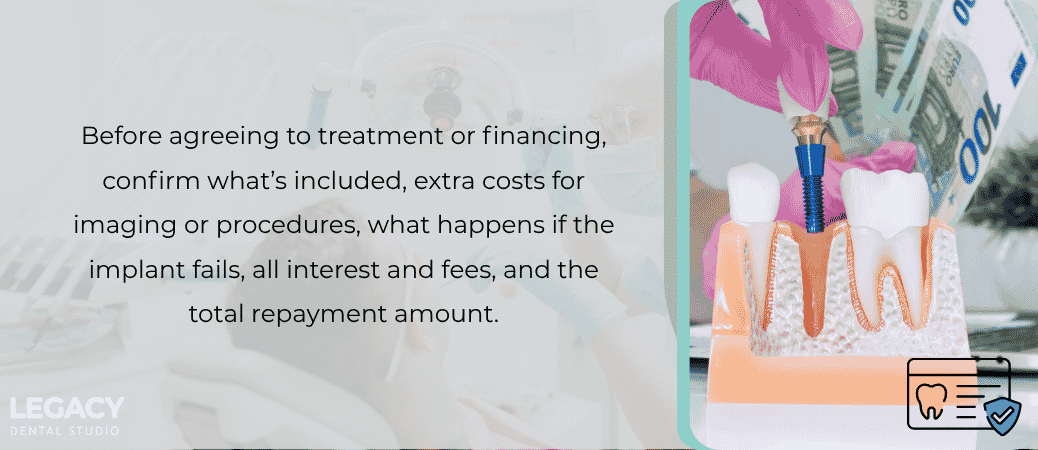
Ask these before committing to any payment plan or treatment agreement:
- What is included in the quoted price, and what's billed separately?
- Is diagnostic imaging like a CBCT scan part of the estimate?
- Will I need extractions, grafting, or a sinus lift, and what would those add?
- What happens financially if the implant doesn't integrate successfully?
- What interest rates, fees, or other financing terms apply to this offer?
- What's my total repayment amount if I take the full term to pay it off?
Getting straight answers to these questions before you sign protects you far more than comparing monthly payment numbers alone.
A Safer Path to an Implant You Can Sustainably Afford
Affording dental implants without insurance starts with understanding your treatment plan and total expected cost. Review available HSA or FSA funds, insurance benefits, payment options, and financing before deciding which approach works for your budget.
When you use financing, review the applicable terms and total repayment amount so you understand the full cost before committing.
A team that walks you through each step, from your first consultation through follow-up care, makes the whole process less stressful. Legacy Dental Studio offers that kind of guidance for patients weighing dental implant financing against other paths, so you can make a decision you feel good about long after the numbness wears off.
Frequently Asked Questions
How much does a single dental implant cost without insurance?
A single dental implant typically costs between $3,000 and $6,000 out of pocket, covering the implant post, abutment, and crown.
Preparatory procedures like bone grafting or extractions can add to that total, so ask for an itemized estimate before you commit.
Can I use an HSA or FSA to pay for dental implants?
Yes, dental implants qualify as an eligible medical expense under both HSA and FSA rules. Using pre-tax dollars from either account lowers your real cost compared to paying with after-tax income, though FSA funds usually need to be used within your plan year.
Is CareCredit a good way to finance dental implants?
Legacy Dental Studio lists CareCredit as one of its available dental financing options. Financing availability and terms can vary, so review the specific offer available to you before using it toward dental implant treatment.
Do dental discount plans cover implants?
Dental discount plans don't cover implants the way insurance does, but they offer a set percentage discount off the total cost at participating providers. They work well for patients who want predictable savings without insurance waiting periods or annual coverage limits.
How can I afford full-mouth dental implants without insurance?
Affording full-mouth dental implants starts with getting a personalized treatment plan so you understand which procedures are needed and what they may cost.
From there, you can review available HSA or FSA funds, insurance benefits, payment options, and financing to determine how the treatment may fit within your budget.